Decision Support for WMS and ERP Implementations That Cannot Be Easily Reversed
I guide organizations to regain control over the business processes that determine the performance of their management systems. I eliminate ambiguities, bottlenecks, and operational risks.
A WMS is increasingly no longer seen merely as an IT tool. In practice, it is part of a business decision that affects operational processes, the distribution of responsibilities, and the way the organization operates. The effectiveness of an implementation depends not on the technology itself, but on how well the system aligns with the organization’s real operating model.
Why Implementations Fail
Most problems don’t stem from technology but from unclear processes, blurred responsibilities, and a lack of a unified view of how the organization operates. As a result, systems become difficult to maintain, changes become costly, and the organization loses the ability to respond quickly.
The most common issues:
❌ High organizational risk of implementations
❌ Lack of process competencies on the business side
❌ Systems not suited to the organization’s scale and maturity
❌ Focus on the system instead of the processes
Incorrect contracts that are:
 More sales-oriented than project-oriented,
Primarily protective of the vendors,
With imprecise scope and responsibilities.
Additionally::
 Decision-making uncertainty at the board level hampers even well-planned projects.
 80 % of problems in ERP/WMS/CRM implementations in SMEs occur before signing the contract, not during execution.
And that is precisely where the greatest attention is most often lacking.
Many companies invest in systems that formally meet their task but, in practice, slow down the organization.
Decision Support in Strategic System Choices
How I work with organizations
I work closely with business and IT teams to ensure a shared language and aligned decisions. Our process models are used as practical working tools — not as one-off documentation.
I organize processes in a way that:
Eliminates uncertainty and responsibility conflicts
Simplifies cooperation between business and IT
Creates a solid foundation for future changes
Processes become the foundation, not an addition, to systems.
I build a shared business-IT context by structuring roles, data, and responsibilities, removing gaps between analysis and implementation.
I create a foundation for growth — processes become the reference point for change, automation, and system scaling. I use advanced tools for designing and analyzing warehouse processes to help prepare the organization for system decisions and implementations.
Stosuję zaawansowane narzędzia do projektowania i analizy procesów magazynowych, które wspomagają przygotowanie organizacji do decyzji systemowych i wdrożeń.
I work with organizations that::
- Are growing and beginning to feel the limitations of their current systems
- Plan to implement or replace key systems
- Want to organize processes before further automation
- Need operational stability during change
If your organization is at one of these moments — you’re in the right place.
What You Gain:
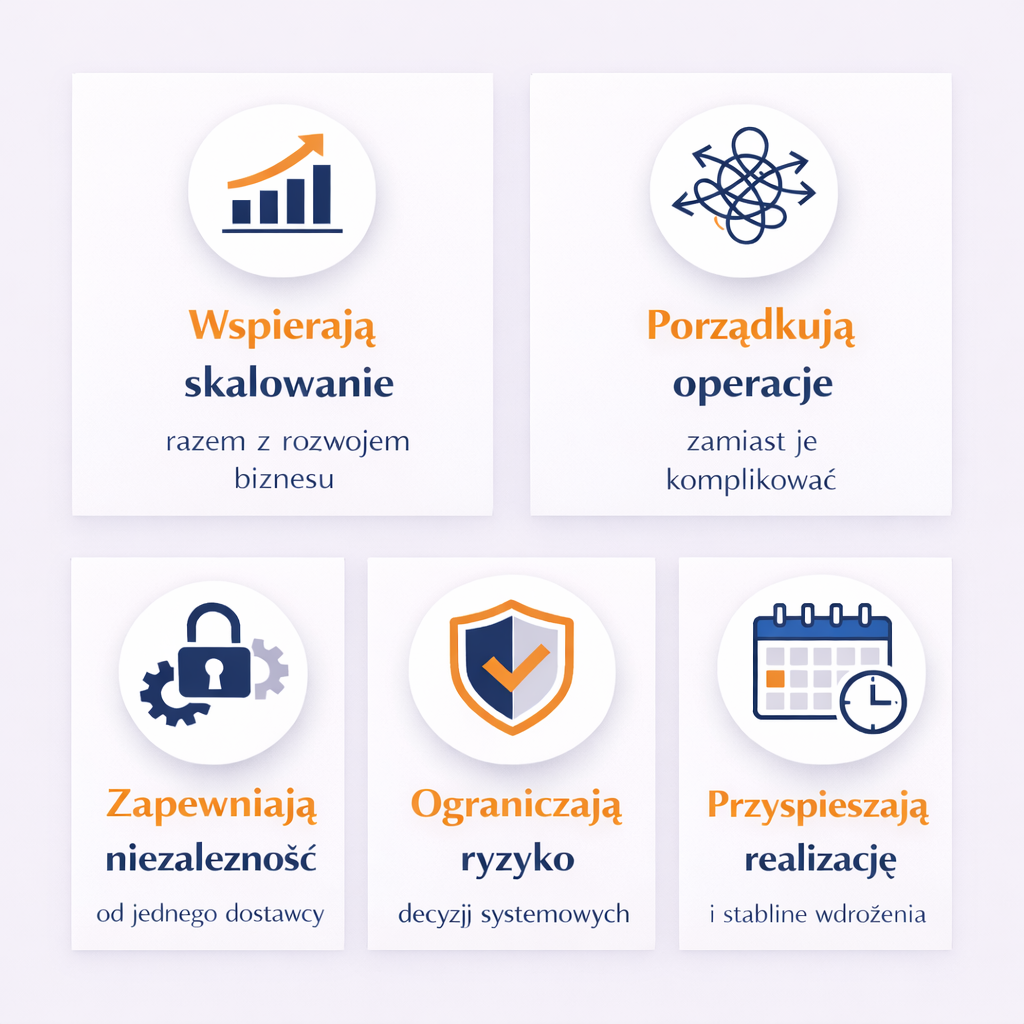
✔ Reduced Implementation Risk
Minimize organizational, technological, and operational risk by working on processes and ensuring implementation consistency with your business model.
✔ Predictable Costs and Schedule
Clearly defined scope, process requirements, and responsibilities reduce ad-hoc changes, uncontrolled cost growth, and project delays.
✔ Operational Stability After Go-Live
We provide stabilization support, eliminating organizational chaos and downtime after launch.
✔ Aligned Processes and Work Organization
The system supports real business processes rather than imposing inconsistent ways of working.
✔ Transparent Accountability, Better Vendor Control, Faster Decisions
Decisions based on a coherent view of processes, data, and real constraints.
✔ Lower Long-Term Operational Costs, Scalability, and Business Continuity
Eliminates inefficiencies and errors caused by system-organization misalignment.
When This Approach Is Most Valuable
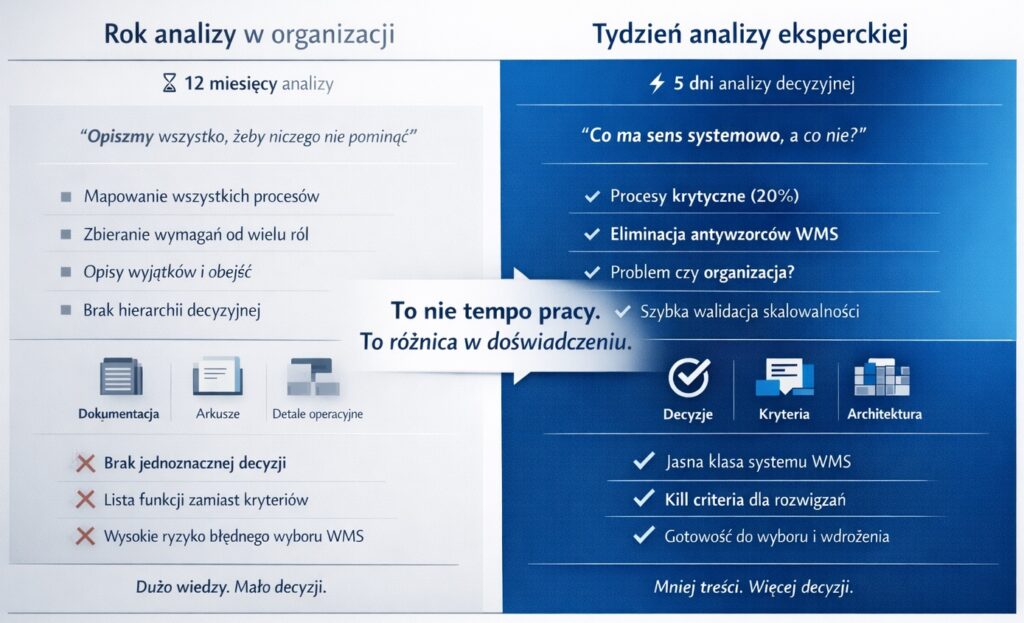
In many organizations, the analysis preceding a WMS implementation drags on for months and results in extensive documentation rather than a clear decision. The difference between a year of analysis and a few days of expert work is not a matter of speed, but of decision-making experience and the ability to filter what truly matters among systemic issues.
🟦 Internal analysis within the organization
mapping all processes without a decision-making hierarchy
collecting requirements from multiple roles, without a shared filter
documenting exceptions and workarounds instead of making system-level decisions
a list of features rather than clear selection criteria
Result: a great deal of operational knowledge, but no unambiguous WMS decision.
🟩 Expert WMS analysis
identification of critical processes (the 20%)
elimination of anti-patterns and false requirements
clear distinction between organizational issues and system-level problems
rapid validation of scalability and system architecture
Result: a clearly defined solution class and readiness to select a WMS.
This is not a difference in the pace of work.
It is a difference in decision-making experience.
Scope of support
The scope of support is not a list of services, but a consequence of the expert way of working.
The areas below illustrate where WMS decision-oriented analysis translates into real action within an organization.
Business process design and structuring – the analysis is conducted strictly within the scope that has a direct impact on system-level decisions.
Preparing the organization for implementation and system change.
Identifying and mitigating risks in contracts with system vendors.
Supporting decision-makers in choices related to the further development of systems.
I do not deliver documentation “for the drawer.”
I create models that genuinely support how the organization operates. I support companies in system-level transformation, encompassing process analysis, the selection of warehouse systems, and a stable operational go-live.
When does this approach deliver the greatest value?
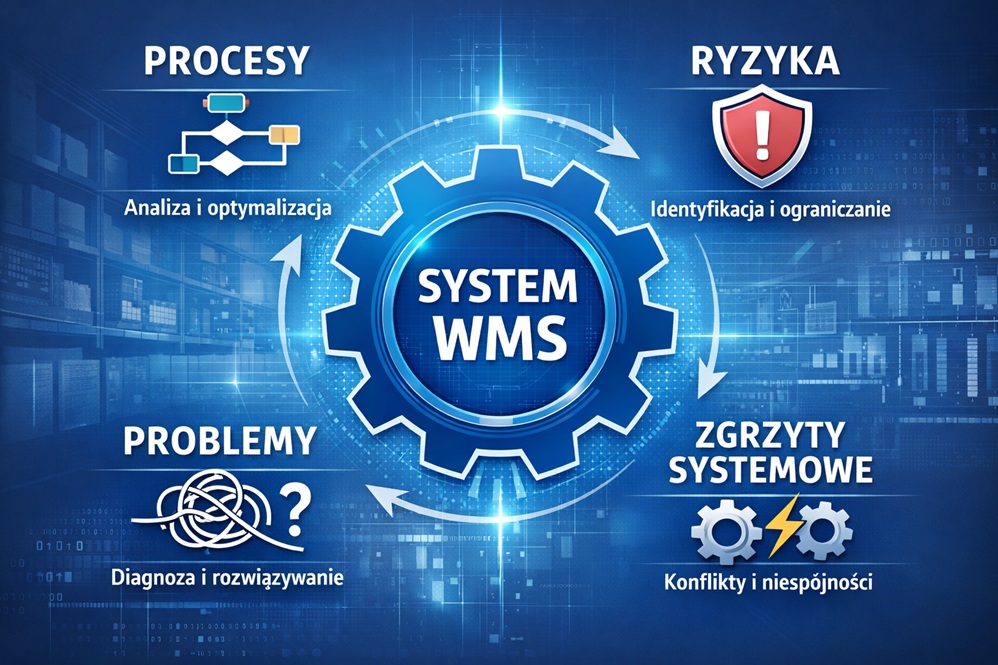
The impact of IT systems on operational processes
Implementing a system that supports warehouse management and operations is no longer an IT project—it becomes a change that affects the entire organization. It reshapes how teams operate, how responsibilities are defined, and how day-to-day operational decisions are made. As a result, the success of such an initiative depends not on the technology itself, but on clearly defined processes and a consciously designed operating model.
Most common situations in which I work with SME management teams
✔ Planned implementation of ERP, WMS, or OMS
The organization wants to make an informed decision and avoid the risk of post–go-live chaos.
✔ Replacement or expansion of an existing system
The current solution no longer supports growth, and every change triggers new operational issues.
✔ Lack of consistent processes and clear ownership
The system “works,” but the organization relies on workarounds, informal knowledge, and manual corrections.
✔ Previous implementations that ended in problems
Management wants to avoid repeating mistakes such as delays, uncontrolled costs, and conflicts with vendors.
✔ Growing scale and organizational complexity
The company is expanding faster than its processes, and existing systems cannot keep up with the change.
Situations in which this approach is not applicable
✖ When the goal is solely to acquire a standard system quickly, without analyzing organizational consequences
✖ When responsibility for system decisions is intended to be shifted entirely to the technology vendor
✖ When the organization is not ready to structure its processes and ways of working
System-level transformation requires decisions and commitment at the management level.